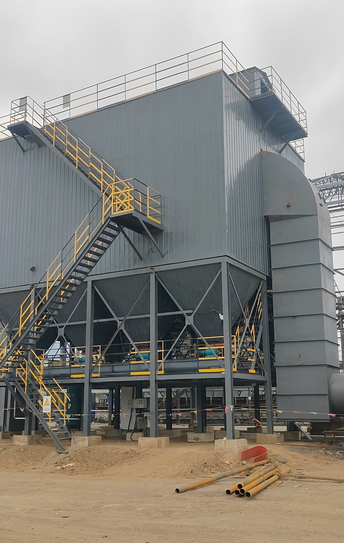
Bag dust collector [1] is a dry dust filtering device. After the filter material is used for a period of time, due to effects such as sieving, collision, retention, diffusion, and static electricity, a layer of dust accumulates on the surface of the filter bag. This layer of dust is called the primary layer. During the subsequent movement, the primary layer becomes the main filter layer of the filter material. Relying on the function of the primary layer, filter materials with larger mesh holes can also obtain higher filtration efficiency. As dust accumulates on the surface of the filter material, the efficiency and resistance of the dust collector increase accordingly. When the pressure difference on both sides of the filter material is large, some small dust particles that have been attached to the filter material will be squeezed out, causing the efficiency of the dust collector to decrease. Besides, high resistance power will significantly decrease air volume of the dust collecting system. Therefore, after the dust collector resistance reaching a certain volume, the dust should be cleaned in time. When cleaning, do not damage the first layer to avoid a decrease in efficiency.
The high dust removal efficiency of bag dust collector is inseparable from its dust removal mechanism. When the dust-containing gas enters the ash hopper from the air inlet pipe at the bottom of the dust collector through the deflector, the coarse dust will fall into the ash hopper due to the collision of the deflector and the reduction of gas velocity. The remaining fine dust particles will enter the filter bag chamber with the gas. Due to the inertia, diffusion, barrier, hooking, and static electricity of the filter fiber and fabric, the dust is blocked in the filter bag. The purified gas escapes out of the bag and is discharged through the exhaust pipe. The dust on the filter bag is removed by gas backwashing. The removed dust goes down to the ash hopper and is discharged to the ash conveying device through the double-layer dust discharge valve. The dust accumulated on the filter bag can also be removed by blowing pulse airflow to achieve the purpose of dust cleaning. The removed dust will be discharged by the dust discharge device. The high dust removal efficiency of the bag dust collector is also inseparable from the filter material. The performance and quality of the filter material are directly related to the performance and service life of the bag dust collector. The filter material is the main material for making filter bags. Its performance and quality promote the advancement of bag dust removal technology and affect its application range and service life. [2]
Filter dust collectors include bag dust collectors and particle layer dust collectors. The former usually uses filter bags made of organic fiber or inorganic fiber fabrics as the filter layer, while the filter layer of the latter is mostly made of particles of different particle sizes, such as quartz sand, river sand, ceramsite, slag, etc. As the powder repeatedly adheres to the outer surface of the filter bag, the powder layer continues to thicken, and the resistance value of the bag dust collector also increases; the pulse valve diaphragm issues a command, and when the left and right are submerged, the pulse valve opens, and the compressed air in the high-pressure air bag passes. If there is no dust or it is small enough, the mechanical dust cleaning work will stop.
The gas purification method of the low-pressure pulse bag dust collector is an external filter type. The dust-containing gas enters the filter chamber of each unit through the guide tube. Since the vertical distance between the bottom of the filter bag and the upper opening of the air inlet is sufficient and reasonable in the design, the air flow is distributed through appropriate diversion and natural flow direction to achieve uniform air distribution in the entire filter chamber. The particulate dust in the dust-containing gas falls directly into the ash hopper after being separated by natural sedimentation. The remaining dust enters the filter area of the middle box with the airflow under the guidance of the diversion system and is adsorbed on the outer surface of the filter bag. The filtered clean gas passes through the filter bag and is discharged through the upper box and exhaust pipe.
The filter bag uses compressed air to blow and clean the dust. The dust cleaning mechanism consists of an air bag, a blow pipe and an electromagnetic pulse control valve. There is a blow pipe installed at the top of the outlet of each row of filter bags in the filter chamber. There is a blow port on the lower side of the blow pipe facing the center of the filter bag. Each blow pipe is equipped with a pulse valve and is connected to the compressed air bag. When cleaning, the solenoid valve opens the pulse valve, and the compressed air is sprayed by the cleaning control device (differential pressure or timing, manual control) to open the electromagnetic pulse injection according to the set program. The compressed gas passes through each pulse valve in a very short time and in order through the nozzle on the injection pipe to induce air several times the injection volume into the filter bag, forming an air wave, causing the filter bag to produce sharp expansion and impact vibration from the bag mouth to the bottom, resulting in a strong cleaning effect and shaking off the dust on the filter bag. [3]